The RAADS-R test, short for the Ritvo Autism Asperger Diagnostic Scale–Revised, is a widely used self-report screening tool designed to help identify autism spectrum traits in adults. As awareness of autism spectrum disorder (ASD) continues to grow globally, more individuals—especially adults—are seeking ways to better understand their behaviors, communication styles, and social experiences.
Unlike many childhood-focused autism assessments, the RAADS-R test is specifically designed for adults who may have gone undiagnosed earlier in life. This article explores what the RAADS-R test is, how it works, its reliability, scoring system, benefits, limitations, and answers to frequently asked questions.
What Is the RAADS-R Test?
The RAADS-R test is a clinically developed questionnaire used to assess autism traits in adults. It was created to support professionals in diagnosing individuals who may fall on the autism spectrum but were not diagnosed during childhood.
The test consists of a series of statements related to behaviors, emotions, and social interactions. Respondents indicate how much each statement applies to them, both currently and in the past. The goal is to identify patterns consistent with autism spectrum disorder.
Purpose of the RAADS-R Test
The primary purpose of the RAADS-R test is to assist in identifying adults who may have autism. It is not intended to replace a professional diagnosis but rather to serve as a screening tool that can guide individuals toward further evaluation.
Many adults seek this test because they:
- Struggle with social communication
- Feel different or misunderstood
- Experience sensory sensitivities
- Have repetitive behaviors or intense interests
The RAADS-R helps bring clarity to these experiences by providing structured insights.
Structure of the RAADS-R Test
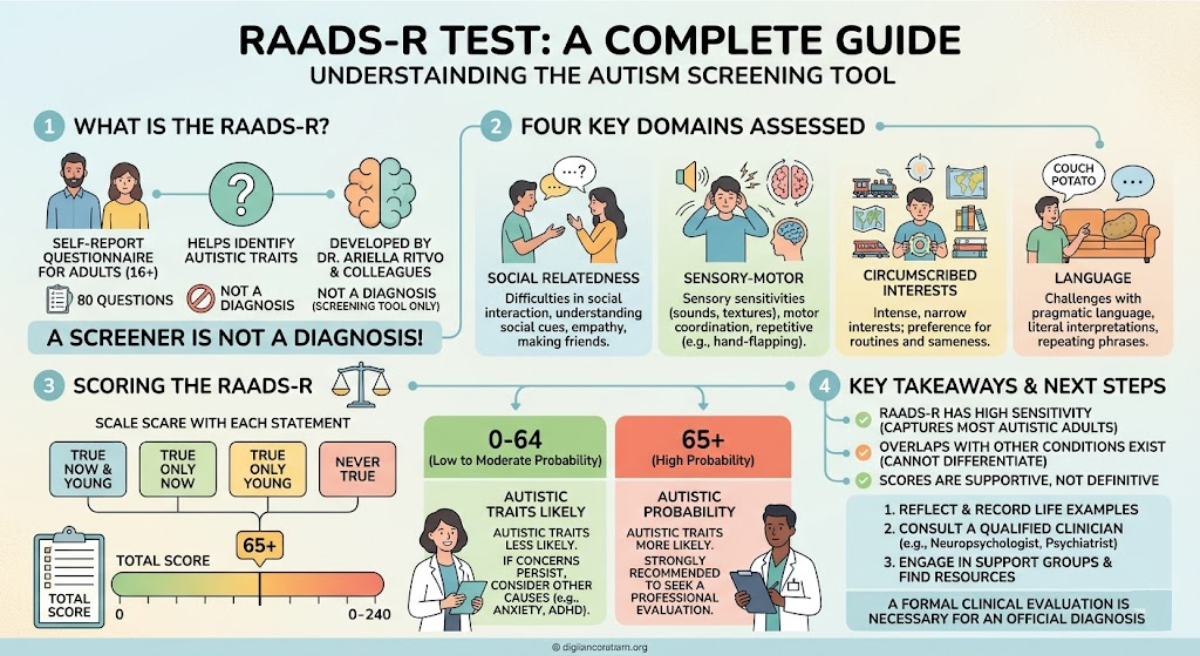
The RAADS-R test typically includes 80 questions divided into four main categories:
1. Social Relatedness
This section evaluates how individuals interact socially, including their ability to understand social cues, maintain relationships, and engage in conversations.
2. Language
This area focuses on communication patterns, including literal interpretation of language, difficulty with metaphors, or unusual speech habits.
3. Sensory-Motor
This category examines sensory sensitivities (such as light, sound, or touch) and motor coordination issues.
4. Circumscribed Interests
This section identifies repetitive behaviors and intense focus on specific topics or activities.
How the RAADS-R Test Works
Each question in the RAADS-R test asks respondents to rate statements based on their experiences. The answers usually follow a scale such as:
- True now and when I was young
- True now only
- True only when I was younger than 16
- Never true
These responses allow the test to capture both current and developmental patterns, which is crucial in autism assessment.
RAADS-R Scoring System
The scoring system of it is designed to quantify autism-related traits. Each response is assigned a numerical value, and the total score is calculated at the end.
Score Interpretation
- Below 65: Typically considered within the non-autistic range
- 65 and above: Suggests the presence of autism traits and may indicate the need for further evaluation
Higher scores indicate a stronger presence of traits associated with autism spectrum disorder.
It’s important to remember that the RAADS-R is not a diagnostic tool. A high score does not confirm autism, but it can be a strong indicator.
Who Should Take the RAADS-R Test?
The RAADS-R test is most suitable for:
- Adults (18+) who suspect they may have autism
- Individuals who were not diagnosed in childhood
- People experiencing long-term social or communication challenges
- Those seeking self-awareness before professional consultation
It is especially helpful for individuals who feel they have been “masking” their behaviors for years.
Benefits of the RAADS-R Test
1. Self-Awareness
The test helps individuals better understand their thoughts, behaviors, and social patterns.
2. Accessibility
It is widely available and can often be completed online or with a clinician.
3. Structured Insight
The categorized approach provides detailed insights into different aspects of behavior.
4. Early Step Toward Diagnosis
It can serve as a starting point for seeking professional help.
Limitations of the RAADS-R Test
While it is useful, it has certain limitations:
1. Not a Diagnostic Tool
Only trained professionals can diagnose autism. The RAADS-R is a screening tool, not a final verdict.
2. Self-Reporting Bias
Results depend on how accurately individuals assess themselves.
3. Cultural Differences
Some questions may not fully account for cultural variations in behavior.
4. Overlapping Conditions
Traits measured by the test may overlap with other conditions such as ADHD, anxiety, or personality disorders.
Accuracy and Reliability
The RAADS-R test has been studied for its effectiveness and is considered a reliable screening tool when used appropriately. Research has shown that it has high sensitivity, meaning it is good at identifying individuals who may have autism.
However, its specificity (ability to rule out non-autistic individuals) can vary. This is why professional evaluation is essential after taking the test.
RAADS-R vs Other Autism Tests
There are several other autism screening tools available, but the RAADS-R stands out for adult assessment.
Compared to AQ (Autism Quotient)
- RAADS-R is more detailed
- AQ is shorter and quicker
Compared to ADOS (Autism Diagnostic Observation Schedule)
- RAADS-R is self-reported
- ADOS is clinician-administered and more comprehensive
The RAADS-R is often used as a preliminary step before more formal testing.
What to Do After Taking the RAADS-R Test
If your score suggests the presence of autism traits, consider the following steps:
1. Consult a Professional
Seek a psychologist or psychiatrist experienced in autism diagnosis.
2. Document Your Experiences
Write down examples of behaviors or challenges that relate to your test results.
3. Explore Support Options
Look into therapy, support groups, or educational resources.
4. Avoid Self-Diagnosis
While self-awareness is valuable, a formal diagnosis ensures accurate understanding and support.
Emotional Impact of the RAADS-R Test
Taking it can be an emotional experience. Some individuals feel relief and validation, while others may feel confusion or anxiety.
Common reactions include:
- “This explains a lot about me.”
- “I finally understand why I feel different.”
- “What should I do next?”
These feelings are completely normal. It’s important to approach the results with curiosity rather than fear.
Misconceptions About the RAADS-R Test
Myth 1: It Diagnoses Autism
Reality: It only screens for traits.
Myth 2: High Score Means Something Is Wrong
Reality: Autism is a neurodevelopmental difference, not a flaw.
Myth 3: Only Introverts Score High
Reality: Autism traits are not limited to personality types.
Importance of Professional Evaluation
A licensed professional will use multiple tools and methods to assess autism, including:
- Clinical interviews
- Behavioral observations
- Developmental history
- Additional diagnostic tests
The RAADS-R test is just one piece of the puzzle.
FAQs About the RAADS-R Test
1. Is the RAADS-R test accurate?
Yes, it is considered a reliable screening tool, but it is not a substitute for a professional diagnosis.
2. Can I take the RAADS-R test online?
Yes, many versions are available online, but results should be interpreted cautiously.
3. What is a normal RAADS-R score?
A score below 65 is generally considered within the typical range.
4. Does a high score mean I have autism?
Not necessarily. It indicates traits associated with autism, but only a professional can confirm a diagnosis.
5. How long does the test take?
It usually takes 20 to 30 minutes to complete.
6. Can the test be wrong?
Like any self-report tool, it can be influenced by personal perception and bias.
7. Is it suitable for teenagers?
The RAADS-R is designed for adults. Other tools are more appropriate for younger individuals.
8. Should I prepare before taking the test?
No special preparation is needed. Honest responses are the most important factor.
Conclusion
The RAADS-R test is a valuable tool for adults seeking to understand whether they may have traits associated with autism spectrum disorder. It provides structured insights into social behavior, communication, sensory experiences, and personal interests.
However, it is essential to remember that the RAADS-R is only a screening tool—not a diagnosis. If your results indicate potential autism traits, the best next step is to consult a qualified professional for a comprehensive evaluation.
Ultimately, the purpose of it is not to label individuals but to empower them with knowledge, self-awareness, and the opportunity to seek appropriate support.