
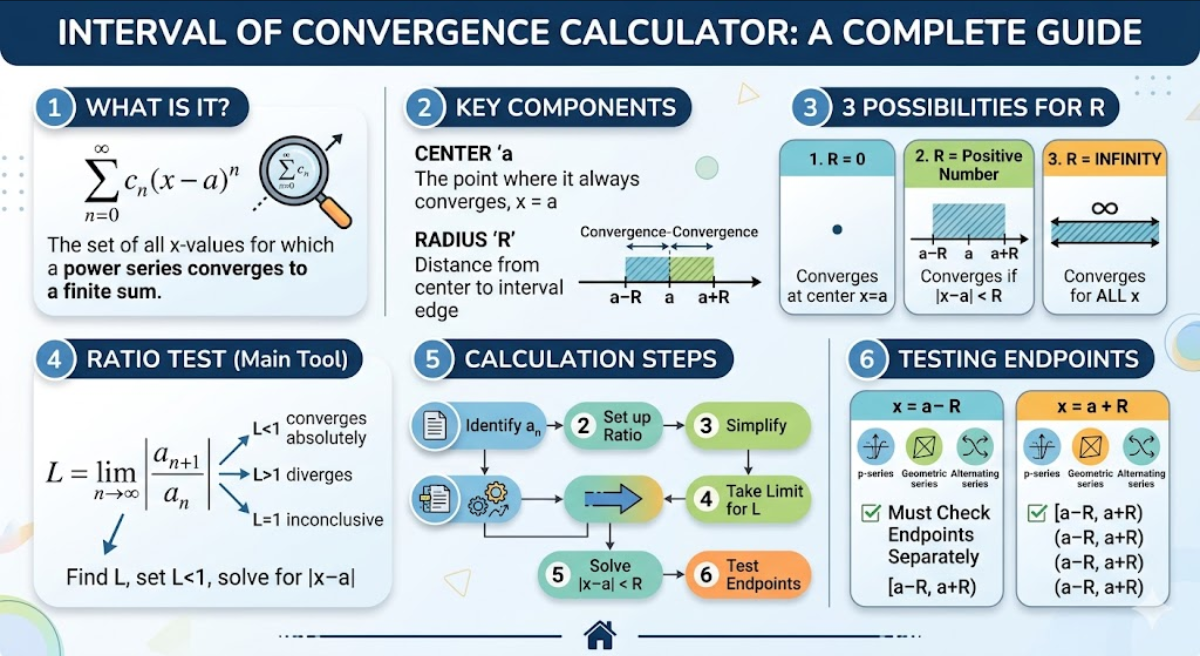
Understanding power series is a fundamental part of calculus and higher mathematics. One of the most important concepts associated with power series is the interval of convergence, which tells us where a series actually works. However, solving these problems manually can sometimes be complex and time-consuming. That’s where an interval of convergence calculator becomes extremely useful.
In this detailed guide, we will explore what an interval of convergence is, how it works, how to calculate it manually, and how a calculator simplifies the process.
What Is an Interval of Convergence?
The interval of convergence is the range of values of xx for which a given power series converges (i.e., produces a finite result).
A typical power series looks like this:
∑n=0∞an(x−c)n\sum_{n=0}^{\infty} a_n (x – c)^n
Here:
- ana_n are coefficients
- cc is the center of the series
- xx is the variable
The interval of convergence defines all values of xx for which the series converges.
Why Is the Interval of Convergence Important?
The interval of convergence is crucial because:
- It tells you where the series is valid
- It helps in approximations using series
- It is widely used in physics, engineering, and economics
- It determines the domain of functions defined by power series
Without knowing the interval, using a power series can lead to incorrect results.
Understanding Convergence and Divergence
Before diving into calculations, it’s important to understand two key terms:
Convergence
A series converges if its sum approaches a finite value as n→∞n \to \infty.
Divergence
A series diverges if it does not approach a finite value.
The interval of convergence includes all values where the series converges.
Steps to Find the Interval of Convergence Manually
To calculate the interval manually, follow these steps:
Step 1: Apply the Ratio Test
The ratio test is commonly used:
limn→∞∣an+1(x−c)n+1an(x−c)n∣\lim_{n \to \infty} \left| \frac{a_{n+1}(x-c)^{n+1}}{a_n (x-c)^n} \right|
Simplify it to find a condition involving xx.
Step 2: Solve the Inequality
The ratio test gives a condition like:
∣x−c∣<R|x – c| < R
Where RR is the radius of convergence.
Step 3: Find the Radius of Convergence
The value RR defines how far the interval extends from the center cc:
R=radius of convergenceR = \text{radius of convergence}
Step 4: Write the Interval
The interval becomes:
(c−R, c+R)(c – R, \, c + R)
Step 5: Check Endpoints
The ratio test does not include endpoints, so test them separately using:
- p-series test
- alternating series test
- comparison test
What Is an Interval of Convergence Calculator?
An interval of convergence calculator is an online or digital tool that automatically computes the interval for a given power series.
Instead of solving complex limits and tests manually, you simply input the series, and the calculator provides:
- Radius of convergence
- Interval of convergence
- Endpoint analysis
How an Interval of Convergence Calculator Works
The calculator follows these steps internally:
- Identifies the general term of the series
- Applies the ratio or root test
- Computes the radius of convergence
- Determines the interval
- Tests endpoints for inclusion
This automation saves time and reduces errors.
Example: Solving Manually vs Calculator
Example Series
∑n=1∞xnn\sum_{n=1}^{\infty} \frac{x^n}{n}
Step 1: Apply Ratio Test
limn→∞∣xn+1/(n+1)xn/n∣=∣x∣⋅nn+1\lim_{n \to \infty} \left| \frac{x^{n+1}/(n+1)}{x^n/n} \right| = |x| \cdot \frac{n}{n+1}
As n→∞n \to \infty, this becomes:
∣x∣|x|
Step 2: Solve Inequality
∣x∣<1|x| < 1
So, R=1R = 1
Step 3: Interval
(−1,1)(-1, 1)
Step 4: Test Endpoints
- At x=1x = 1: series becomes harmonic → diverges
- At x=−1x = -1: alternating harmonic → converges
Final Answer
[−1,1)[-1, 1)
Using a Calculator
An interval of convergence calculator would instantly give:
- Radius: 1
- Interval: [-1, 1)
No manual work required.
Advantages of Using an Interval of Convergence Calculator
1. Saves Time
Complex calculations are done instantly.
2. Reduces Errors
Manual mistakes are eliminated.
3. Helpful for Students
Ideal for homework, assignments, and exam preparation.
4. Handles Complex Series
Works even with factorials, exponentials, and complicated expressions.
Limitations of Calculators
While useful, calculators have some limitations:
- May not show full step-by-step solutions
- Requires correct input format
- Over-reliance may weaken conceptual understanding
That’s why it’s important to understand the manual method as well.
Tips for Using an Interval of Convergence Calculator
- Always double-check your input
- Understand the result, don’t just copy it
- Practice manual solving alongside calculator use
- Use it as a verification tool
Common Mistakes to Avoid
Ignoring Endpoints
Many students forget to test endpoints separately.
Misapplying the Ratio Test
Errors often occur while simplifying limits.
Confusing Radius with Interval
The radius is just a number; the interval includes actual values of xx.
Not Simplifying Properly
Always simplify expressions before applying tests.
Real-Life Applications
The concept of interval of convergence is used in:
Engineering
For solving differential equations.
Physics
In wave functions and quantum mechanics.
Economics
For modeling growth and decay.
Computer Science
In numerical methods and approximations.
When Should You Use a Calculator?
Use an interval of convergence calculator when:
- The series is too complex
- You need a quick answer
- You want to verify your solution
- You are practicing multiple problems
Manual vs Calculator: Which Is Better?
| Aspect | Manual Method | Calculator |
|---|---|---|
| Accuracy | Depends on skill | High |
| Speed | Slow | Fast |
| Learning | Strong understanding | Limited |
| Complexity Handling | Difficult | Easy |
Best approach: Use both together.
FAQs
1. What is the interval of convergence in simple terms?
It is the range of values of xx for which a power series produces a finite result.
2. What is the difference between radius and interval of convergence?
The radius is a single number, while the interval is the full range of values including endpoints (if applicable).
3. Can endpoints always be included?
No. Each endpoint must be tested separately to determine whether it converges or diverges.
4. Which test is best for finding the interval?
The ratio test is most commonly used, but sometimes the root test is also applied.
5. Are interval of convergence calculators accurate?
Yes, most calculators are accurate if the input is correct.
6. Do I still need to learn manual methods?
Absolutely. Calculators help, but understanding the concept is essential for exams and deeper learning.
7. What happens if the radius is zero?
The series only converges at a single point (the center).
8. What if the radius is infinite?
The series converges for all real numbers.
Conclusion
The interval of convergence is a key concept in understanding power series and their behavior. While solving these problems manually builds strong mathematical skills, using an interval of convergence calculator makes the process faster and more efficient.
For best results, combine both approaches—learn the theory, practice manually, and use calculators for verification. This balanced method ensures accuracy, speed, and deep understanding.