Understanding how time is divided can sometimes feel confusing, especially when you’re trying to break months into weeks. A very common question people ask is: how many weeks in a month? While the answer might seem straightforward at first, it actually depends on how you look at it. In this article, we’ll explore this topic in detail, explain the math behind it, and clear up any confusion.
Understanding the Basics of Time Measurement
Before diving into the exact number of weeks in a month, it’s important to understand how time is structured.
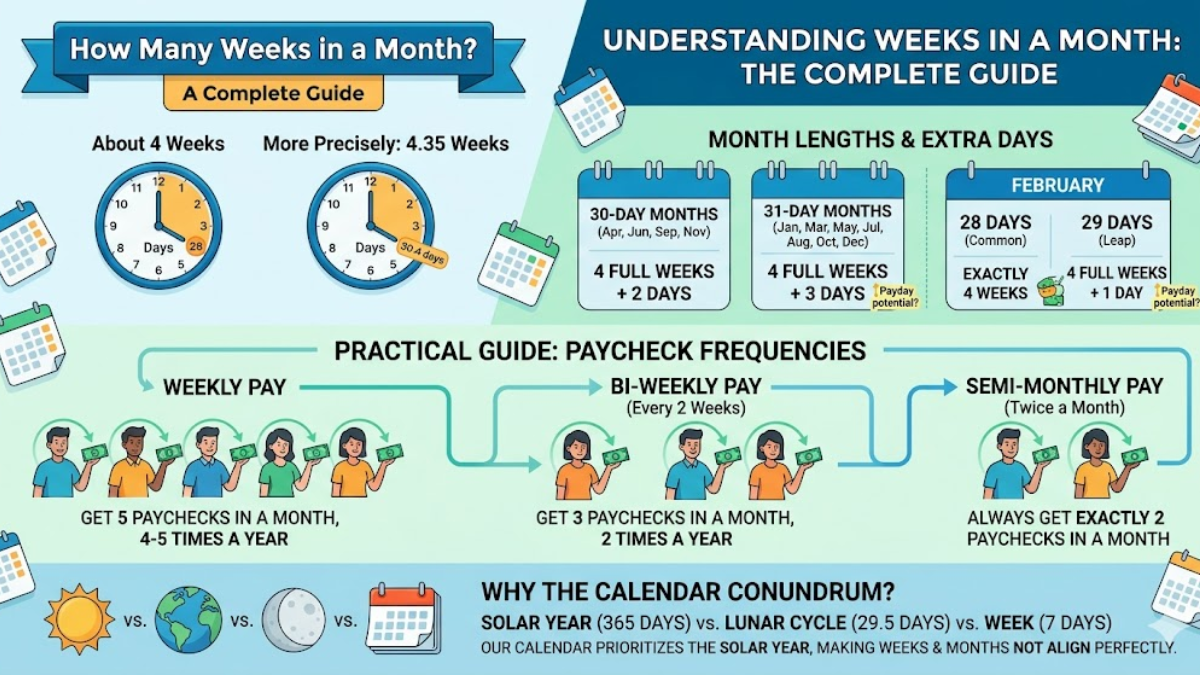
A week consists of 7 days. A month, however, does not have a fixed number of days. Instead, months can have:
- 28 days (February in common years)
- 29 days (February in leap years)
- 30 days (April, June, September, November)
- 31 days (January, March, May, July, August, October, December)
Because the number of days varies, the number of weeks in a month also changes.
The Simple Answer: Average Weeks in a Month
If you’re looking for a quick answer, the average number of weeks in a month is:
About 4.33 weeks
This comes from dividing the total number of days in a year by weeks and months:
- 1 year = 365 days
- 365 ÷ 7 = 52.14 weeks
- 52.14 ÷ 12 ≈ 4.33 weeks per month
So, on average, each month has a little more than 4 weeks.
Breaking It Down by Days
Let’s look at how many weeks each type of month contains:
28-Day Month
- 28 ÷ 7 = 4 weeks exactly
This only applies to February in a non-leap year.
29-Day Month
- 29 ÷ 7 = 4 weeks and 1 day
This occurs during leap years in February.
30-Day Month
- 30 ÷ 7 = 4 weeks and 2 days
This applies to months like April and June.
31-Day Month
- 31 ÷ 7 = 4 weeks and 3 days
This applies to months like January and July.
Why Months Don’t Have Exactly 4 Weeks
Many people assume a month has exactly 4 weeks, but that would only equal 28 days. Since most months are longer than 28 days, they naturally include extra days beyond 4 full weeks.
Those extra days are why:
- Some months appear to stretch across 5 calendar weeks
- Weekly schedules shift from month to month
- Payroll or billing cycles can vary
Calendar Perspective: Weeks vs Calendar Rows
When looking at a calendar, you might notice that some months span 5 weeks. This can be confusing, but it’s important to understand why.
A calendar displays weeks in rows, and a new row begins every time a new week starts. Even if a month only has 30 or 31 days, it can still spread across 5 rows because:
- The month doesn’t always start on the first day of the week
- Extra days spill into a new row
So, visually, a month may show 5 weeks, even though it technically has just over 4 weeks.
Real-Life Examples
Let’s take a practical look at how this works:
Example 1: February (28 days)
- Starts on Monday
- Ends on Sunday
- Exactly 4 full weeks
Example 2: August (31 days)
- Starts on a Friday
- Ends on a Sunday
- Spans 5 calendar rows
Even though August shows 5 rows on a calendar, it still contains only 4 weeks and 3 extra days.
Weeks in a Month for Planning Purposes
Understanding how many weeks are in a month is useful for:
1. Budgeting
If you’re planning monthly expenses, knowing that a month is roughly 4.33 weeks helps you:
- Allocate weekly spending
- Adjust for months with extra days
2. Work Schedules
Employers often calculate work hours based on:
- Weekly shifts
- Monthly totals
A month may include slightly more than 4 weeks of work, affecting total hours.
3. Fitness and Habit Tracking
If you set weekly goals, remember:
- A month is not exactly 4 weeks
- You’ll have extra days to maintain consistency
4. Academic Planning
Students and teachers often plan:
- Weekly lessons
- Monthly syllabi
Knowing the extra days helps avoid falling behind.
How Many Weeks Are in a Year vs a Month
To better understand the concept, let’s compare:
- 1 week = 7 days
- 1 year = 52 weeks + 1 day (or 2 in leap years)
- 1 month ≈ 4.33 weeks
This comparison shows why months can’t be evenly divided into whole weeks.
Common Misconceptions
Misconception 1: Every Month Has 4 Weeks
This is incorrect. Only a 28-day month has exactly 4 weeks.
Misconception 2: A Month Always Has 5 Weeks
This confusion comes from calendar layouts. A month may appear to have 5 weeks but doesn’t contain 5 full weeks.
Misconception 3: Weeks Fit Perfectly into Months
Because months vary in length, weeks don’t align perfectly with them.
Leap Years and Their Impact
Leap years slightly change the calculation:
- February has 29 days instead of 28
- This adds an extra day to the year
However, the average number of weeks per month (4.33) remains almost the same.
Converting Weeks to Months
Sometimes you may want to convert weeks into months. Here’s a simple method:
- 1 month ≈ 4.33 weeks
- 4 weeks ≈ 0.92 months
- 8 weeks ≈ 1.84 months
- 12 weeks ≈ 2.76 months
This is useful for:
- Pregnancy tracking
- Project timelines
- Subscription planning
Practical Tip: When Precision Matters
If accuracy is important, don’t rely on averages. Instead:
- Count the exact number of days
- Divide by 7 to get weeks
This method ensures precise results for scheduling or calculations.
Cultural and Calendar Differences
Different cultures and systems may define weeks and months slightly differently, but the modern calendar used worldwide follows:
- 7-day weeks
- 12 months with varying lengths
So, the concept of weeks per month remains consistent globally.
Summary of Key Points
- A week has 7 days
- Months have 28 to 31 days
- A month contains 4 to 4.43 weeks
- The average is 4.33 weeks per month
- Calendar layouts may show 5 weeks, but not 5 full weeks
FAQs About How Many Weeks in a Month
1. How many full weeks are in a month?
Most months have 4 full weeks, with additional extra days depending on the month length.
2. Why do some months look like they have 5 weeks?
This happens because of how calendars are arranged. A month can span 5 rows even if it doesn’t contain 5 complete weeks.
3. Is 4 weeks equal to 1 month?
No, 4 weeks equal 28 days, while most months have 30 or 31 days.
4. What is the exact number of weeks in a month?
There is no single exact number because months vary. However, the average is 4.33 weeks.
5. How many weeks are in February?
- 28 days = 4 weeks
- 29 days (leap year) = 4 weeks and 1 day
6. How do you calculate weeks in a specific month?
Divide the number of days in that month by 7. The result will give full weeks plus extra days.
7. How many weeks are in 30 days?
30 days equal 4 weeks and 2 days.
8. How many weeks are in 31 days?
31 days equal 4 weeks and 3 days.
9. Why is the average 4.33 weeks?
Because a year has 52 weeks and 12 months, dividing gives approximately 4.33 weeks per month.
10. Does this affect salaries or billing?
Yes, especially for weekly payments or subscriptions, since months are slightly longer than 4 weeks.
Final Thoughts
The question how many weeks in a month doesn’t have a single fixed answer, but understanding the reasoning behind it makes things much clearer. While the average is about 4.33 weeks, the exact number depends on the number of days in each month. By keeping this in mind, you can plan your time, finances, and schedules more effectively.
Time may not always divide perfectly, but once you understand its patterns, it becomes much easier to manage.