
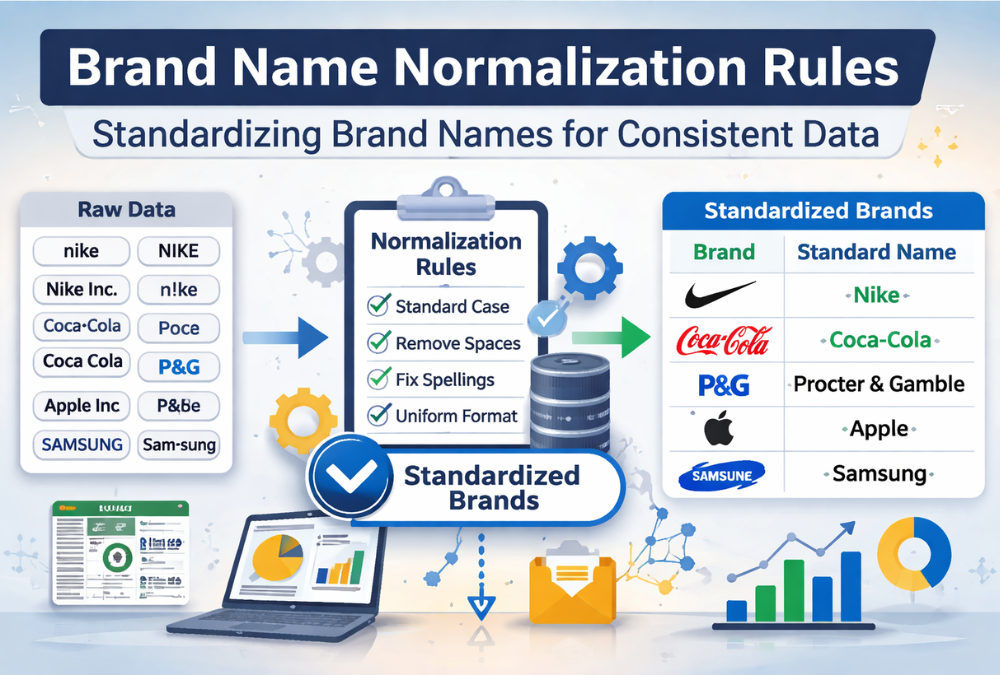
In today’s data-driven world, consistency is everything. Whether you are managing product catalogs, e-commerce listings, marketing campaigns, or large datasets, maintaining uniformity in brand names is crucial. This is where brand name normalization rules come into play. These rules help standardize variations in brand names, ensuring clarity, accuracy, and improved data usability across systems.
Brand name inconsistencies can arise from typos, abbreviations, different naming conventions, or regional variations. Without proper normalization, these inconsistencies can lead to duplicate records, poor analytics, and reduced search efficiency. This article explores the concept of brand name normalization rules, why they matter, and how to implement them effectively.
What Are Brand Name Normalization Rules?
Brand name normalization rules are a set of guidelines and processes used to standardize how brand names are written, stored, and displayed across systems. These rules eliminate inconsistencies and ensure that all references to a brand follow a single, uniform format.
For example, a brand like “Coca-Cola” might appear as:
-
Coca Cola
-
coca-cola
-
COCA COLA
-
Coke
Normalization rules ensure that all these variations are converted into a single standardized form, such as “Coca-Cola.”
Why Brand Name Normalization Matters
1. Improved Data Quality
Inconsistent brand names lead to fragmented data. Normalization ensures that all entries referring to the same brand are unified, improving overall data quality.
2. Better Search and Filtering
When users search for a brand, normalized data ensures accurate and complete results. Without normalization, some entries may be missed due to spelling or formatting differences.
3. Enhanced Analytics
Accurate reporting depends on clean data. Normalized brand names allow businesses to generate reliable insights, such as sales performance by brand.
4. Consistent User Experience
Customers expect consistency. Seeing different variations of the same brand can create confusion and reduce trust.
Common Challenges in Brand Name Normalization
Variations in Spelling
Brands may be spelled differently due to typos or regional preferences.
Use of Abbreviations
Some brands are commonly abbreviated, which can create inconsistencies.
Special Characters and Symbols
Hyphens, apostrophes, and ampersands can vary in usage.
Case Sensitivity
Brand names may appear in uppercase, lowercase, or mixed case.
Multilingual Differences
Global brands may have localized versions of their names.
Core Brand Name Normalization Rules
1. Standardize Case Formatting
Choose a consistent case style, such as:
-
Title Case (e.g., Nike)
-
Uppercase (e.g., NIKE)
Most organizations prefer Title Case for readability.
2. Remove Extra Spaces
Eliminate leading, trailing, and multiple spaces between words.
Example:
-
“ Apple Inc ” → “Apple Inc”
3. Handle Special Characters
Decide how to treat special characters like:
-
Hyphens (-)
-
Ampersands (&)
-
Apostrophes (’)
Example:
-
“H&M” → “H and M” (if removing symbols)
4. Normalize Abbreviations
Create rules for expanding or standardizing abbreviations.
Example:
-
“P&G” → “Procter and Gamble”
5. Correct Common Misspellings
Maintain a dictionary of frequently misspelled brand names and map them to the correct version.
6. Remove Legal Suffixes (Optional)
Some organizations choose to remove suffixes like:
-
Inc.
-
Ltd.
-
LLC
Example:
-
“Samsung Electronics Co., Ltd.” → “Samsung”
7. Standardize Synonyms and Aliases
Some brands are known by multiple names. Normalize them into one.
Example:
-
“Google” and “Alphabet” (depending on context)
8. Maintain a Master Brand List
Create a centralized list of approved brand names. This acts as the source of truth for normalization.
Techniques for Implementing Brand Name Normalization
Rule-Based Approach
This involves defining explicit rules for formatting and transforming brand names. It is simple and effective for smaller datasets.
Dictionary Mapping
Create a mapping table where variations are linked to a standardized brand name.
Example:
-
“nikee” → “Nike”
-
“NIKE” → “Nike”
Machine Learning Approaches
Advanced systems use machine learning to identify patterns and automatically normalize brand names. These are useful for large-scale datasets.
Fuzzy Matching
Fuzzy matching algorithms help identify similar brand names based on string similarity.
Best Practices for Brand Name Normalization
1. Define Clear Standards
Document your normalization rules clearly so that all teams follow the same guidelines.
2. Automate Where Possible
Manual normalization is time-consuming. Use tools and scripts to automate the process.
3. Regularly Update Rules
Brands evolve over time. Keep your normalization rules updated with new variations and trends.
4. Validate Data Continuously
Implement validation checks to ensure new data follows normalization rules.
5. Involve Domain Experts
Marketing or branding teams can provide insights into correct brand naming conventions.
Use Cases of Brand Name Normalization
E-commerce Platforms
Online stores rely on normalized brand names for accurate product listings and filtering.
Data Analytics
Clean brand data enables accurate reporting and better decision-making.
Customer Relationship Management (CRM)
CRMs use normalized brand names to avoid duplicate entries and improve customer insights.
Search Engines
Normalization improves search accuracy by ensuring consistent indexing of brand names.
Tools for Brand Name Normalization
Several tools and technologies can assist in normalization:
-
Data cleaning tools
-
Spreadsheet functions
-
Programming languages like Python
-
Data integration platforms
Choosing the right tool depends on the size and complexity of your dataset.
Example Workflow for Brand Name Normalization
-
Data Collection – Gather raw brand name data
-
Preprocessing – Remove noise such as extra spaces and symbols
-
Rule Application – Apply normalization rules
-
Mapping – Match variations to standard names
-
Validation – Check for errors or inconsistencies
-
Storage – Save normalized data in a centralized system
Benefits of Effective Brand Name Normalization
-
Reduced data duplication
-
Improved operational efficiency
-
Better customer insights
-
Enhanced reporting accuracy
-
Consistent branding across platforms
Future Trends in Brand Name Normalization
AI-Powered Normalization
Artificial intelligence is making normalization smarter and more adaptive.
Real-Time Data Processing
Systems are increasingly normalizing data in real-time as it is entered.
Integration with Big Data Systems
Normalization is becoming a core part of data pipelines in large organizations.
Conclusion
Brand name normalization rules are essential for maintaining clean, consistent, and reliable data. Whether you are running an e-commerce platform, managing a CRM, or analyzing large datasets, standardized brand names improve efficiency and accuracy across the board.
By implementing clear rules, leveraging the right tools, and continuously refining your approach, you can ensure that your data remains consistent and valuable. As data continues to grow in importance, mastering brand name normalization will be a key competitive advantage.
FAQs
What is brand name normalization?
Brand name normalization is the process of standardizing different variations of a brand name into a single, consistent format.
Why is brand name normalization important?
It improves data quality, enhances search accuracy, and ensures consistent user experiences.
What are common issues in brand name normalization?
Common issues include spelling variations, abbreviations, special characters, and inconsistent formatting.
How do you normalize brand names?
You can use rule-based methods, mapping dictionaries, fuzzy matching, or machine learning techniques.
Can brand name normalization be automated?
Yes, many tools and algorithms can automate the normalization process, especially for large datasets.
What is a master brand list?
A master brand list is a centralized repository of standardized brand names used as a reference for normalization.
How often should normalization rules be updated?
Normalization rules should be updated regularly to reflect new brands, variations, and market changes.
Is normalization useful for small businesses?
Yes, even small businesses benefit from consistent data, especially in customer management and reporting.