
Bees are among the most fascinating and essential creatures in our ecosystem. Known for their role in pollination and honey production, they are usually seen buzzing around flowers during sunny days. But a common question many people have is: do bees fly at night?
The short answer is that most bees are active during the day and rest at night. However, the full explanation is much more interesting and involves biology, evolution, and environmental adaptation. In this article, we’ll explore whether bees fly at night, why most don’t, and which rare species break this rule.
Understanding Bee Activity Patterns
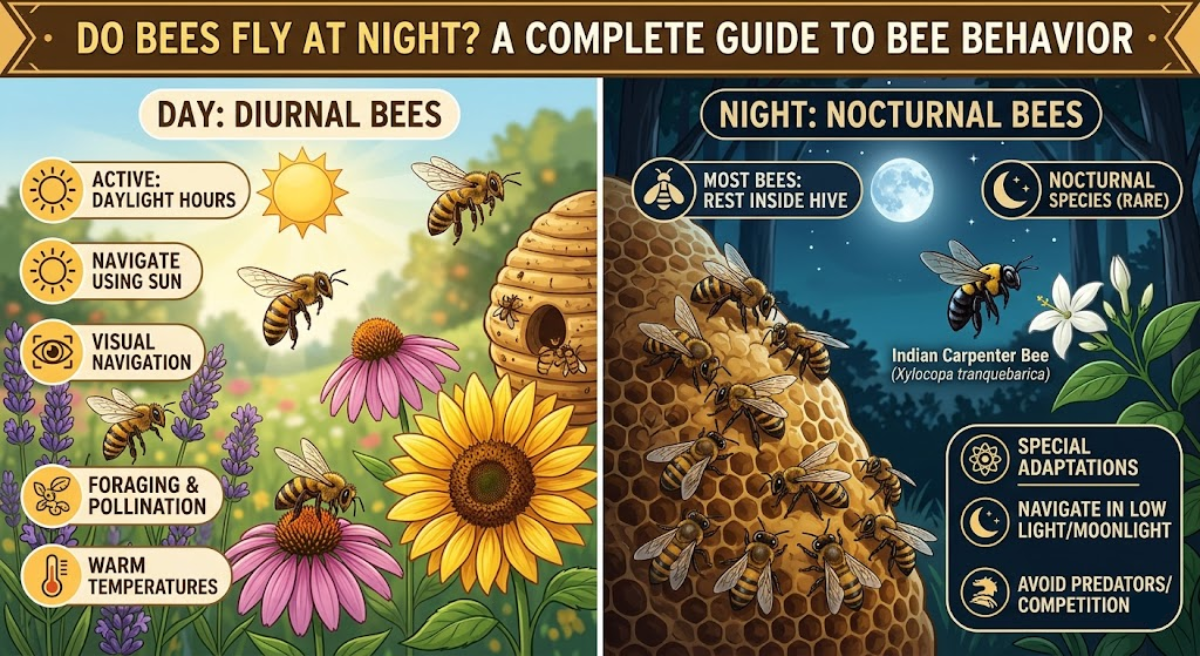
Most bees are diurnal, which means they are active during the daytime. Their daily routine revolves around sunlight because it helps them navigate, locate flowers, and communicate with other bees.
During the day, bees:
- Search for nectar and pollen
- Pollinate plants
- Return to their hive or nest with food
- Communicate food sources through movements like the waggle dance
At night, bees typically:
- Rest inside their hive
- Conserve energy
- Protect themselves from predators
This natural cycle is essential for their survival and efficiency.
Why Most Bees Do Not Fly at Night
1. Dependence on Sunlight for Navigation
Bees rely heavily on sunlight to navigate. They use the position of the sun as a compass and can even detect polarized light patterns in the sky. Without sunlight, their ability to find flowers and return home becomes much more difficult.
2. Vision Limitations
Most bees have eyes that are adapted for daylight vision. Their compound eyes are excellent at detecting movement and color in bright conditions, especially ultraviolet light, which helps them locate flowers. However, these eyes are not designed for low-light or nighttime environments.
3. Flower Availability
Flowers typically produce nectar and open during the day. Since bees depend on flowers for food, there is little benefit in flying at night when most plants are closed and inactive.
4. Temperature and Energy Efficiency
Nighttime temperatures are usually cooler, which can slow down a bee’s metabolism. Flying requires a lot of energy, and bees need warm conditions to keep their muscles active. Staying in the hive at night helps them conserve energy.
Do Any Bees Fly at Night?
While most bees are daytime creatures, there are exceptions. Some species have adapted to function in low-light or even nighttime conditions.
Nocturnal Bees
A small number of bee species are truly nocturnal, meaning they are active at night. These bees have developed special adaptations that allow them to operate in darkness.
Examples include:
- Certain tropical bees found in Central and South America
- Species from the genus Megalopta
These bees have:
- Larger eyes to capture more light
- Enhanced sensitivity to dim conditions
- Slower but more careful flight patterns
Crepuscular Bees
Some bees are not fully nocturnal but are crepuscular, meaning they are active during dawn and dusk. These times offer lower competition and fewer predators, making them advantageous for certain species.
How Nocturnal Bees Navigate in the Dark
Nocturnal bees use several strategies to function without sunlight:
1. Enhanced Vision
Their eyes are larger and more sensitive than those of daytime bees. This allows them to detect faint light sources such as moonlight or starlight.
2. Memory and Landmarks
These bees rely heavily on memory. They remember the location of flowers and nests and use environmental landmarks to guide them.
3. Slow and Careful Movement
Unlike daytime bees that move quickly, nocturnal bees tend to fly more slowly to avoid obstacles and conserve energy.
Where Are Night-Flying Bees Found?
Night-flying bees are more common in tropical and subtropical regions. These environments provide stable temperatures and consistent floral resources that may be available even at night.
In contrast, regions with cooler climates (like much of Europe or North America) have very few nocturnal bee species because the nighttime conditions are less favorable.
What Happens Inside the Hive at Night?
While most bees are inactive outside, the hive itself is still somewhat active at night.
Rest and Recovery
Worker bees rest to recover from the day’s activities. This rest period is essential for maintaining their energy levels and efficiency.
Temperature Regulation
Bees work together to maintain the hive’s temperature. Even at night, some bees may move their wings to circulate air and keep conditions stable.
Protection
The hive becomes more defensive at night. Guard bees remain alert to protect against predators or intruders.
Do Honeybees Ever Fly at Night?
Honeybees, the most commonly known type of bee, are strictly daytime foragers. They almost never fly at night.
However, there are rare situations where honeybees might appear active after dark:
- Artificial lighting (such as streetlights) may confuse them
- Disturbances to the hive can cause temporary activity
- Extremely warm conditions might extend their activity slightly into evening
Even in these cases, true nighttime flight is uncommon.
How Artificial Light Affects Bees
Modern environments with artificial lighting can disrupt natural bee behavior.
Disorientation
Bright lights can confuse bees and interfere with their navigation system.
Extended Activity
Some bees may stay active longer than usual due to artificial light, but this can lead to exhaustion.
Ecological Impact
Changes in bee activity patterns can affect pollination cycles and plant reproduction.
Why Bee Activity Timing Matters
The timing of bee activity is crucial for ecosystems. Since most plants rely on daytime pollinators, bees and flowers have evolved together in a synchronized relationship.
If bees were to become nocturnal:
- Pollination patterns would change
- Certain plants might struggle to reproduce
- Entire ecosystems could be affected
This is why the diurnal nature of bees is so important.
Common Myths About Bees and Night Activity
Myth 1: Bees Sleep All Night
While bees rest, they do not sleep in the same way humans do. They enter a state of reduced activity but can quickly respond to threats.
Myth 2: Bees Are Completely Inactive at Night
Although they don’t fly, bees inside the hive still perform essential tasks like temperature regulation and protection.
Myth 3: All Bees Avoid Darkness
As discussed earlier, some species have adapted to thrive in low-light conditions.
Comparison: Bees vs Other Night-Flying Insects
Unlike bees, many insects are naturally nocturnal.
Moths
Moths are nighttime pollinators and are attracted to light. They often pollinate flowers that bloom at night.
Mosquitoes
Mosquitoes are most active during dusk and nighttime, taking advantage of cooler temperatures.
Beetles
Some beetles are also nocturnal and play roles in pollination and decomposition.
This highlights how bees occupy a specific ecological niche as daytime pollinators.
Conclusion
So, do bees fly at night? The answer is mostly no. The vast majority of bees are active during the day and rest at night due to their reliance on sunlight, vision limitations, and the availability of flowers.
However, nature always has exceptions. A few specialized species have evolved to operate in low-light or nighttime conditions, showcasing the incredible adaptability of bees.
Understanding these patterns not only satisfies curiosity but also helps us appreciate the delicate balance of ecosystems and the vital role bees play in maintaining it.
FAQs
1. Do bees ever come out at night?
Most bees do not come out at night. They stay in their hive to rest and conserve energy. Only a few rare species are active after dark.
2. Why don’t bees fly at night?
Bees rely on sunlight for navigation and finding flowers. Their eyes are not well-suited for darkness, and most flowers are closed at night.
3. Are there any bees that are active at night?
Yes, some tropical bee species are nocturnal or active during low-light conditions like dawn and dusk.
4. Do honeybees fly at night?
No, honeybees are strictly daytime insects and rarely fly after dark unless disturbed or affected by artificial light.
5. Where do bees go at night?
Bees return to their hive or nest, where they rest, regulate temperature, and stay protected from predators.
6. Can artificial light make bees fly at night?
Artificial lighting can confuse bees and may cause limited activity, but it does not make them truly nocturnal.
7. What insects pollinate at night instead of bees?
Moths, certain beetles, and other nocturnal insects take over pollination duties at night.
8. Do bees sleep like humans?
Bees do not sleep like humans, but they enter a resting state where their activity decreases and their bodies recover.